Account-Based Marketing: Reaching Hard-to-Reach B2B Audiences with Location Targeting
Account-Based Marketing: Reaching Hard-to-Reach B2B Audiences with Location Targeting
Category: General
What can you do when you know exactly which B2B audience you want to reach, but conventional targeting options are not precise enough?
This is where a company’s location can become relevant.
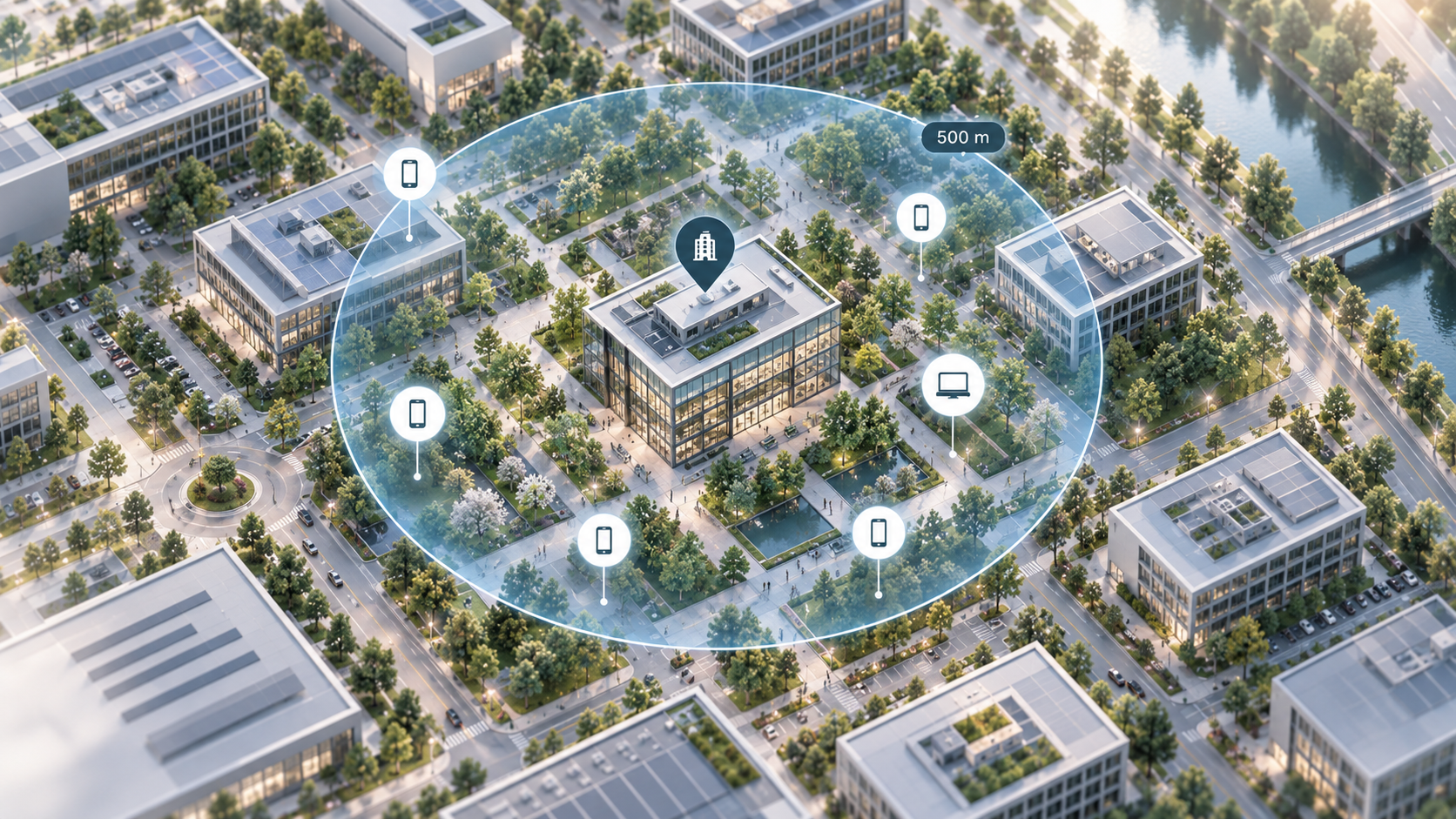
If the target accounts have already been identified, specific delivery areas can be defined around their locations. This adds another targeting factor alongside industry, job function or interests: physical proximity to a relevant company.
When conventional B2B targeting reaches its limits
For small or highly specialised audiences, standard targeting criteria are often not sufficient.
Location targeting, also known as geofencing, can be a useful addition. Instead of targeting a broader audience based on general characteristics, advertisers can focus on specific business locations, such as production sites, company headquarters, branch offices, industrial estates or trade fair venues.
Example: A mechanical engineering company wants to reach decision-makers within the automotive supplier industry. The relevant production sites are known, but individual contacts are difficult to identify accurately based on industry or job title alone.
In this case, the production site itself can be used as the delivery area, allowing employees at that location to be reached during working hours.
What does this have to do with Account-Based Marketing?
Account-Based Marketing focuses on selected target companies.
The aim is not to generate the widest possible reach, but to identify which accounts are relevant to the company’s offering and which audience should be reached within those accounts.
Location targeting can be an additional element of this approach.
The distinction is important: a geographical radius alone does not constitute ABM. The connection to Account-Based Marketing only comes from deliberately selecting relevant accounts and aligning the communication with those accounts.
How precisely can the audience be narrowed down?
Depending on the location, target areas can be defined from a certain radius. How small that radius can be depends on the advertising platform being used.
Whether a very small radius makes sense also depends heavily on the surrounding area. A standalone company site can be defined much more clearly than an office complex or a large industrial estate.
The key consideration is therefore not to make the radius as small as possible, but to select and define the locations carefully.
Why desktop also plays a role
The main focus is usually on mobile devices, as location-based signals tend to be more relevant there.
However, at locations with traditional office environments, desktop traffic can account for a noticeably larger share. This means users may also be reached via their workplace computers.
Depending on the location and technical setup, mobile and desktop can complement each other and cover both mobile and more traditional professional touchpoints.
Takeaway
ABM does not replace a clearly defined target audience; it complements it.
If the relevant accounts are already known and conventional targeting options are not precise enough, the company location can provide an additional way to reach the desired audience.
For small, hard-to-reach B2B audiences in particular, this can make Account-Based Marketing significantly more targeted.